
Anthropic opened a research preview of Claude Duet this week, an agent that keeps working after the chat window closes. It is not another place to type prompts. Duet is designed to act on its own, then come back when it needs permission.
What Claude Duet actually does
Duet runs on Claude Opus 5.5 and lives on iOS, Android and the web. US customers on the Pro and Max tiers can request access through a waitlist. Team and Enterprise plans are not included yet.
Inside the app, Duet produces a daily briefing from connected services. It can schedule meetings, build dashboards, prepare forecasts, draft invoices or prototype a web app. The work happens on a cloud virtual machine, so the user’s laptop can stay off.
Anthropic says the agent can reach more than 6,000 connectors and plug-ins from the Claude Marketplace. That includes Gmail, Slack, Stripe, DocuSign and Shopify. Purchases run through Stripe Link or Shopify Shop Pay. The virtual card means Duet does not need the user’s real card number.
Trust is the product
Anthropic’s pitch is control. Duet can read, draft and prepare without asking. It pauses for approval before sending messages, paying, signing documents or deleting files. It cannot trade securities or move money between accounts, even with approval.
The company also added a classifier that screens every message for sensitive data. By default, Duet refuses requests for card numbers and government ID. According to Anthropic, Duet cannot view passwords or sign-in tokens. Red teams and an outside firm tested the system for prompt injection.
That sounds reassuring, but it also sets expectations. Approval gates are only useful if they are rare enough to feel like control and clear enough to be understood. An agent that asks too often becomes another inbox. One that asks too little becomes a liability.
Why Claude Duet is late to the agent race
Claude Duet arrives after several rivals. xAI opened the Grok Bot beta in August. Meta launched Muse in September, and OpenAI followed with Dots the same month. All three are chasing the same shift: from assistants that answer to agents that act.
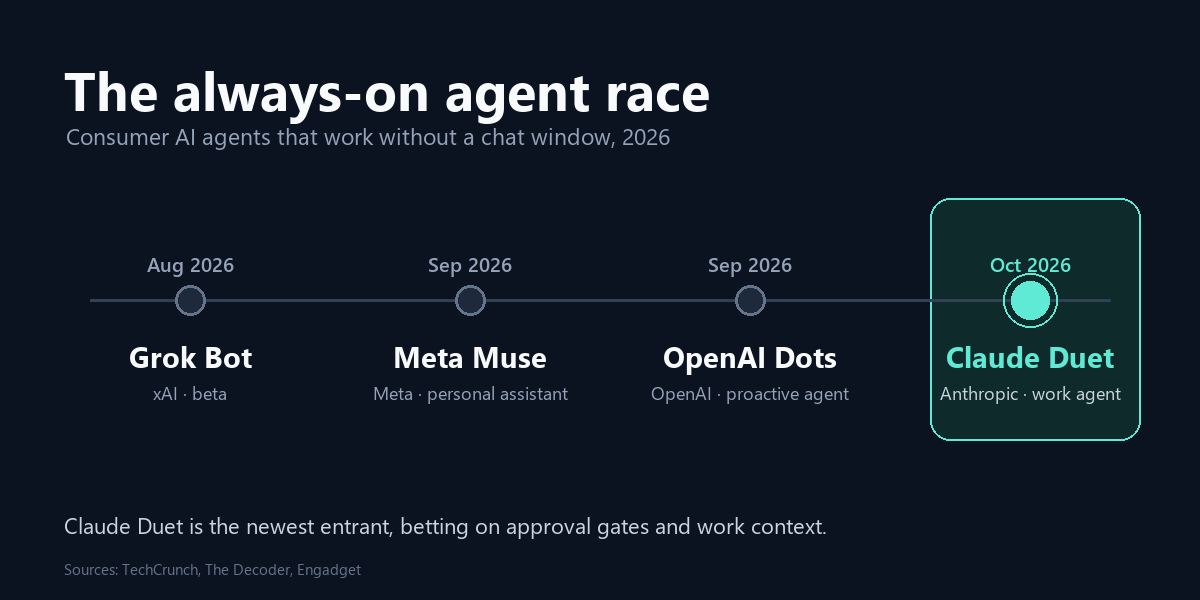
Anthropic’s angle is work, not errands. Duet is aimed at professionals and small businesses. It is explicitly weaker at booking tickets or handling personal chores. The bet is that people will pay for an agent that understands their work context, not one that can do everything.
The limits are part of the pitch
Anthropic admits the preview has gaps. Duet can misread a long thread, misjudge urgency or miss something that arrives between checks. It checks connected accounts every few hours, not continuously. Constant polling would burn through usage limits faster.
That matters because Duet shares limits with other Claude products. Background checks count against the same allowance as chats and coding sessions. Heavy users may find the agent competes with the tools they already rely on.
Access is another question. Engadget reports that Pro subscribers on the $20 plan will get Duet at general availability. OpenAI’s Dots are currently limited to its Pro tier, which starts at $100 a month. If that comparison holds, Anthropic is positioning Duet as the cheaper work agent. The research preview is free to try, but the waitlist is not a rollout.
What to watch
The real test is not whether Claude Duet can do impressive demos. It is whether it can be trusted with the boring, repetitive work that fills a professional’s day. That requires reliable connectors, good judgment about when to interrupt, and clear logs of what the agent did.
Anthropic has an advantage in enterprise trust. Claude is already sold to companies that care about data handling and model behavior. Duet extends that relationship into everyday workflows. But the consumer agent market is crowded, and Microsoft, Google and Meta can bundle similar features into products people already use.
The pricing math is unresolved. A $20 plan that includes an always-on agent could be expensive to serve. Anthropic is limiting checks and sharing usage caps for a reason. If Duet becomes popular, the company will have to balance subscription revenue against compute costs.
Regulators will also watch. An agent that reads email, touches payments and acts without a human in the loop raises familiar questions about liability and consent. Anthropic’s approval gates are a useful start. They are not a complete answer.
Claude Duet is a clear statement of where Anthropic thinks the assistant market is going. The chatbot is becoming a worker, and the interface is becoming a relationship built on permission. The company is asking users to hand over context in exchange for time.
That trade only works if Duet earns it. The preview will show whether Anthropic can make an always-on agent feel less like a new app and more like a reliable colleague. More AI agent coverage.

Brian Shannon is just getting his start a reporter. He attended a technical school while still in high school where he learned a variety of skills, from photography to car mechanics. Brian also helps keep Techno Secrets social media feeds up-to-date.