
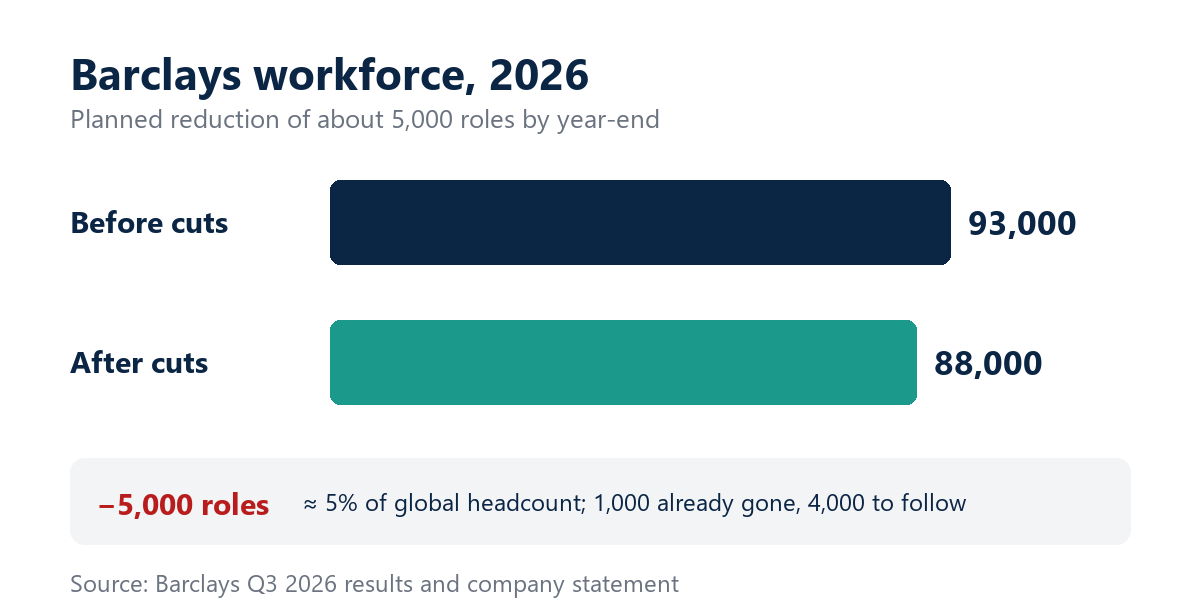
Barclays AI job cuts will remove about 5,000 roles by the end of the year. That is roughly 5% of its 93,000-strong global workforce. The UK lender is leaning on artificial intelligence and a multi-year technology overhaul to bring down costs.
Barclays disclosed the cuts on Thursday alongside third-quarter results that showed pre-tax profit of £2.3bn. That was up 12% from a year earlier but below the £2.4bn analysts had forecast. The bank also announced a further £500m share buyback, taking total shareholder returns since January to £2.8bn.
What the Barclays AI job cuts actually mean
Chief financial officer Anna Cross told reporters that about 60% of the reductions would fall in support functions. That includes fewer developer roles. AI makes staff more productive, she said. Around 1,000 jobs have already gone this year. The bank expects to remove the rest by the end of December.
The Barclays AI job cuts sit inside a wider efficiency programme. Management is targeting more than £1.1bn of savings in 2027. In the third quarter it booked £201m of structural cost actions, after about £200m of efficiency savings. It expects roughly £300m more in the final three months of the year.
That framing matters. This is not a single AI-driven layoff event. It is a cost programme running alongside the final stretch of a three-year turnaround plan. Automation and AI are helping the bank justify fewer people in support roles. Those jobs sit behind the businesses rather than in front of customers.
Why the AI caveat matters
Chief executive CS Venkatakrishnan was careful about how much credit AI deserves. He described the technology as “icing on the cake” after years of investment in the bank’s infrastructure. Modernising that infrastructure and simplifying processes had driven most of the efficiency gains so far, he said. AI may matter more in the future.
That is a more cautious message than the headline number implies. Banks have spent years consolidating systems, moving workloads to the cloud and automating manual checks. Generative AI and coding assistants can accelerate that work. But they sit on top of changes that were already underway. The risk is that investors treat the Barclays AI job cuts as proof of an AI dividend. The savings have to appear in the accounts first.
The quarter was mixed. Group income came in at £7.4bn, while the investment bank generated £3.1bn, below forecasts of £3.3bn. Equity trading income rose 47%, but fixed income trading fell 19%. Venkatakrishnan said he was disappointed with a traditional strength. Barclays shares slipped 0.1% on the day and are down about 12% this year.
Why banks are trimming support teams
Barclays is not alone. Standard Chartered has said it will cut more than 7,000 jobs over four years. That targets roughly one in seven back-office roles by 2030. Reuters noted that Microsoft and HSBC have also announced layoffs this year as automation spreads through large employers.
Support functions are the obvious target because their work is often repetitive and document-heavy. Software maintenance, compliance checks, reconciliation, reporting and internal services all fit that description. Coding assistants can reduce the number of developers needed to maintain legacy systems. Document tools can speed up reviews that once required large teams.
But the net effect is not automatically negative for employment. Banks are still hiring for AI, data engineering, risk and cyber roles. They also need people to govern the systems they deploy. The unresolved question is whether the jobs created pay as well and sit in the same places as the ones removed. For a UK lender with a large back-office footprint, that is a political question. It is also an operational one. More AI coverage tracks how those roles change.
What to watch next
Three tests will decide whether this looks like a genuine productivity shift. Or whether it is a familiar cost cut with new terminology.
First, the 2027 savings target. Barclays has to show that £1.1bn in savings arrives without degrading controls. It also has to avoid slowing lending or breaking customer service. Cost programmes that run ahead of automation often return as remediation spending later.
Second, the UK budget on 28 October. Banks expect a higher levy. Venkatakrishnan has said an increase would be bearable but is a question of proportion and market signalling. If taxes rise while headcount falls, political scrutiny of bank profits will intensify.
Third, the rest of the sector. If Barclays hits its targets, rivals may follow with similar developer and support cuts. AI would then become the standard explanation for bank restructuring. If savings disappoint, the industry will have to be more precise about what the technology can actually replace.
The 5,000 figure is the headline. The more important number is the £1.1bn. If the Barclays AI job cuts deliver that saving while keeping controls intact, the case for AI-driven cost cuts across finance will strengthen. Missing it would suggest that, for now, AI is still the icing rather than the cake.

Brian Shannon is just getting his start a reporter. He attended a technical school while still in high school where he learned a variety of skills, from photography to car mechanics. Brian also helps keep Techno Secrets social media feeds up-to-date.